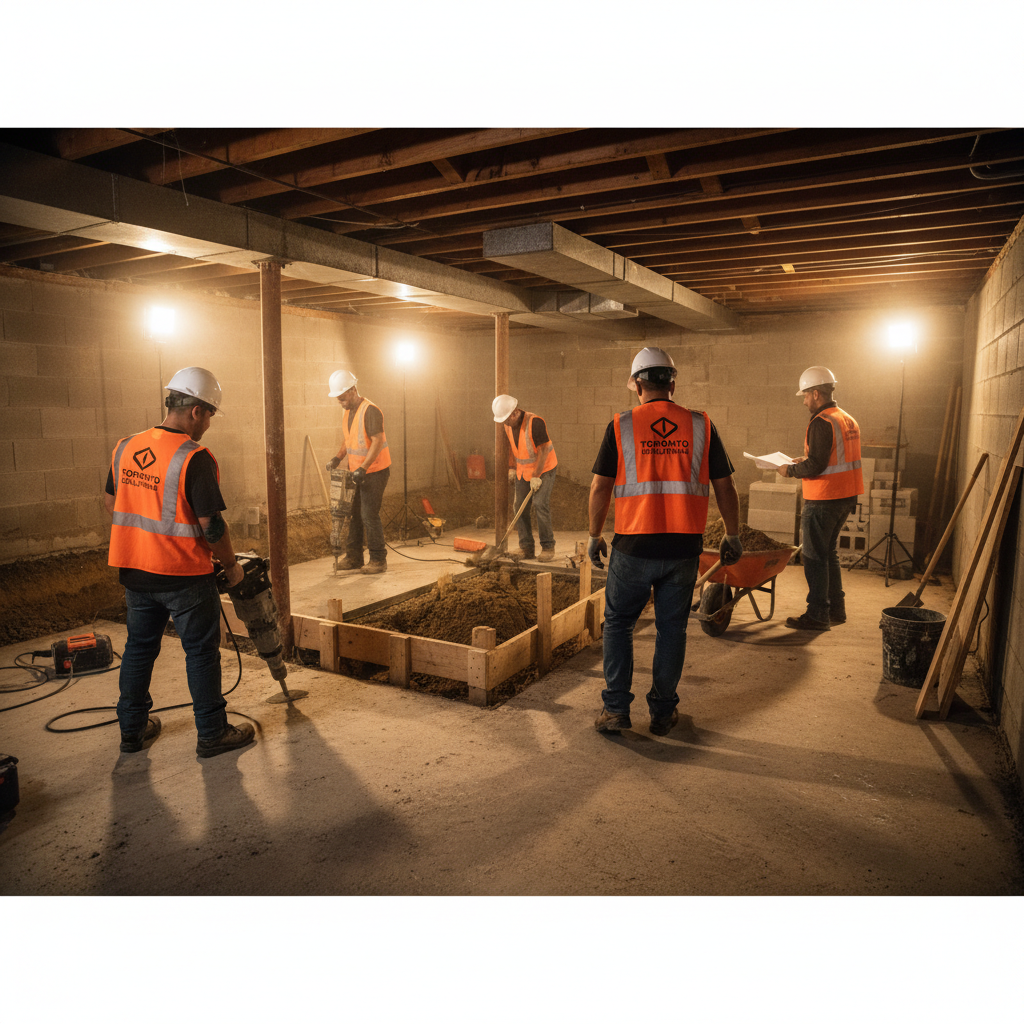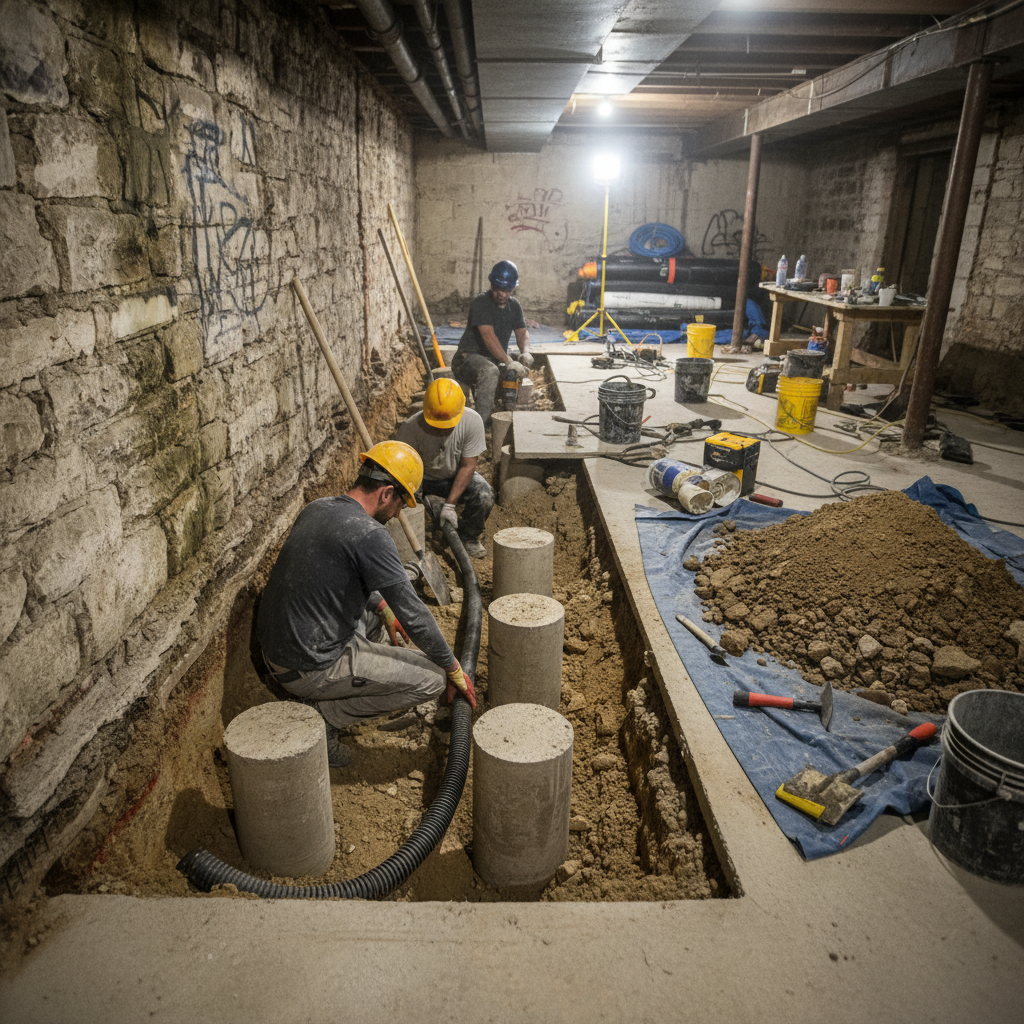
When a basement underpinning project is in the planning stage, one of the most important decisions a Toronto homeowner can make is whether to include interior waterproofing in the same scope. This decision is made only once. The window for cost-efficient waterproofing installation closes when the new concrete slab is poured.
If waterproofing is installed during underpinning, the drainage channel is integrated into the open trench that already exists from the underpinning excavation. The concrete pour covers both the underpinning fill and the drainage channel in a single operation. If waterproofing is deferred until after the underpinning is complete and the slab is poured, the contractor must saw-cut that fresh concrete to install the drainage channel, then pour again.
The cost of that deferred decision is $3,000 to $6,000 on a typical Toronto basement.
What Happens During Each Approach
Combined Approach (Waterproofing During Underpinning)
Sequence:
- Underpinning excavation and footing pours proceed per the pin-section sequence
- Below-slab plumbing rough-ins are installed after the last footing cures
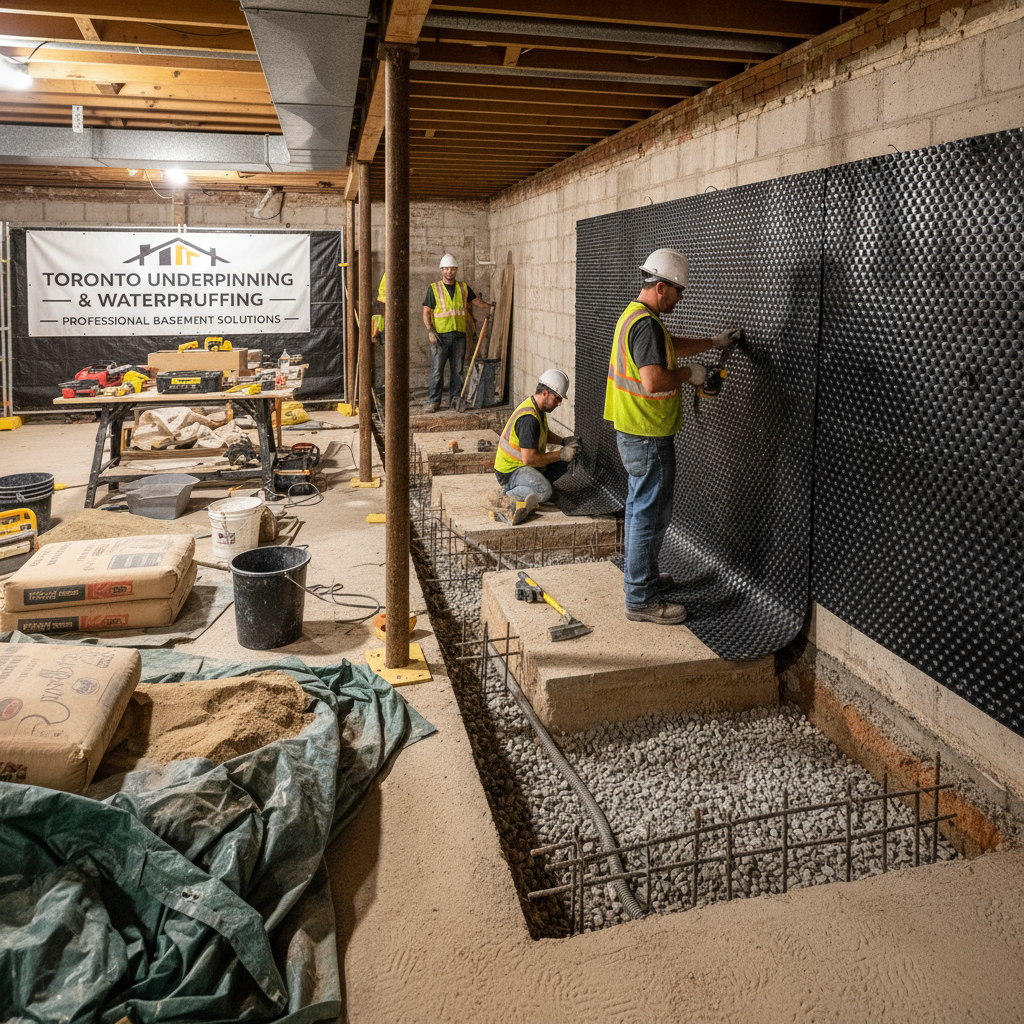
- Drainage channel and gravel bed are laid in the perimeter trench
- Delta MS membrane is installed on the foundation walls
- Sump pit is excavated and liner is set
- A single slab pour covers the drainage gravel, connects the plumbing stubs, and sets the new floor level
What this achieves: One concrete pour, one mobilization for both structural and waterproofing scope, and a drainage channel that is installed with full access to the footing base.
Sequential Approach (Waterproofing After Slab)
Sequence after underpinning is complete:
- New concrete slab from underpinning has cured (28 days minimum)
- Waterproofing crew arrives and saw-cuts the perimeter of the new slab
- Concrete cut-out is removed and disposed of
- Drainage channel and gravel are installed
- Membrane is installed on walls
- New concrete patch covers the channel
What this costs additionally: Saw cutting ($8 to $15/LF), concrete disposal (additional haul away of fresh concrete that was just poured), and a second partial concrete pour. These added costs plus the second mobilization bring the standalone waterproofing rate to $80 to $120/LF versus $50 to $80/LF during underpinning.
The Cost Comparison
| Scenario | Per Linear Foot | Typical 140-LF Project | Notes |
|---|---|---|---|
| Waterproofing during underpinning | $50 to $80/LF | $7,000 to $11,200 | No saw cutting; shared trench |
| Standalone waterproofing (after slab) | $80 to $120/LF | $11,200 to $16,800 | Saw cutting; fresh concrete |
| Savings from combining | $30 to $40/LF | $4,200 to $5,600 | Before sump, pump, and membrane |
The savings of $4,200 to $5,600 on the drainage channel component alone represent roughly the cost of a battery backup sump pump system. Put differently: the savings from combining the projects typically pay for the sump pump and battery backup entirely.
What Gets Installed in the Combined Scope
When waterproofing is included in the underpinning scope, the installation includes:
Drainage channel: PVC perforated drain tile or Delta drainage channel installed in the perimeter trench at the base of the new footing, sloped toward the sump pit. The channel sits in a gravel bed that allows water to enter from the footing-wall junction.
Dimple membrane: Delta MS or equivalent high-density polyethylene dimple membrane installed on the foundation walls from the channel level upward, typically to 1 to 1.2 metres height. The membrane creates an air gap allowing water to drain down to the channel.
Sump pit: Excavated in the lowest point of the drainage system, typically 36 to 42 inches deep, with a perforated liner that allows groundwater to enter the pit.
Sump pump: Primary pump installed in the pit with float switch, check valve, and discharge line to exterior. The discharge line is routed through the wall or floor to a point at least 1.5 metres from the foundation.
Optional battery backup: A DC backup pump and battery system that activates during power outages. Adding battery backup at this stage costs $800 to $1,500 incremental, which is the same cost as adding it later.
Which Toronto Homes Benefit Most
While the cost savings from combining apply to any underpinning project, certain homes benefit most strongly:
Pre-1960 homes (essentially all Toronto homes built before 1960). These homes have original drainage systems that are at or near the end of their design life. Adding a modern interior drainage system during underpinning gives these homes another 25 to 50 years of protected operation.
Homes with a history of moisture. If the basement has had any prior moisture (efflorescence on walls, seepage during spring, past flooding), the underpinning project is the right time to permanently resolve it. Doing underpinning without waterproofing and then experiencing moisture in the finished basement means revisiting the problem with a saw.
Homes targeting a legal secondary suite. A finished secondary suite with moisture problems is a liability and a tenant relations disaster. Waterproofing during underpinning gives the suite the best possible moisture performance from day one.
Any home over 50 years old. At 50 years, original exterior waterproofing (if any was applied at original construction, which was not standard practice for pre-1960 Toronto homes) has typically reached the end of its practical life. Interior waterproofing during underpinning replaces this function.
The Argument Against Waiting
Some homeowners choose to defer waterproofing with the reasoning: “I will do it later if I need it.” This reasoning has a structural flaw.
After underpinning is complete and the new slab is poured, the basement will be dry for a period. The new slab is fresh and has no cracks. There is no water entry. The homeowner proceeds with finishing: framing, drywall, flooring, paint. The basement looks perfect.
Then, two or three years later (after the new slab has settled, developed hairline cracks, and after a particularly wet spring), water begins to enter. Now the homeowner must:
- Tear out sections of finished drywall and framing to access the perimeter
- Saw-cut the slab that they just paid to pour
- Install the drainage channel they could have had for $3,000 to $6,000 less during underpinning
- Patch the slab
- Repair the framing and drywall
- Repaint
The total cost of this scenario is the original waterproofing cost plus $5,000 to $15,000 in finished basement repair. The alternative was spending $3,000 to $6,000 more during underpinning.
For further context, read our guides on Interior Waterproofing Process and Underground Plumbing During Underpinning.
Planning an underpinning project and considering whether to include waterproofing? Contact our team for a combined scope assessment with cost comparison between the two approaches.