Toronto has hundreds of thousands of homes with foundation cracks. The vast majority of them are harmless. A small percentage of them are serious. Knowing which category your crack falls into is the difference between a $700 injection job and missing a progressive structural problem that costs $60,000 to fix after it gets worse.
This guide gives you the framework that structural engineers and experienced contractors use to classify foundation cracks, assess severity, and decide on the appropriate response.
Why Toronto Homes Crack
Before classifying crack types, it helps to understand the forces at work in Toronto’s specific geological and climate context.
Frost heave. Toronto’s frost line is 1.2 metres (4 feet). Every winter, the soil surrounding foundations freezes and expands. This exerts enormous lateral and vertical pressure on foundation walls and footings. Homes with shallow footings (common pre-1920 in The Annex, Cabbagetown, and Roncesvalles) are particularly vulnerable.
Clay soil expansion. Much of Toronto sits on clay and till soil that expands when wet and contracts when dry. This seasonal movement creates cyclical stress on foundation walls, particularly horizontal stress during wet spring seasons.
Tree roots. Toronto’s urban tree canopy is extensive. Large tree roots can exert significant hydraulic pressure against foundation walls as they grow, and root extraction can leave soil voids that cause localized settlement.
Normal concrete shrinkage. Poured concrete shrinks slightly as it cures. This shrinkage creates internal tension that results in hairline to moderate-width vertical cracks in poured walls. These are the most common type in post-1950 homes and are often benign.
Settlement. Inadequate footings, poorly compacted backfill, erosion of soil under footings, or changes in the soil moisture environment can cause settlement that manifests as cracks.
Crack Classification System
Level 1: Hairline Cracks (Width less than 0.3mm)
Hairline cracks are thinner than a credit card and are typically caused by concrete shrinkage during curing. In poured concrete walls, these are nearly universal and are not a structural concern on their own.
When they require attention: If a hairline crack is allowing water seepage (even a small amount during heavy rainfall), it should be sealed. Water infiltration through a hairline crack can enlarge the crack through freeze-thaw cycles over multiple winters, eventually creating a larger problem.
Action: Monitor for 12 months. Seal with polyurethane injection if water entry occurs.
Level 2: Minor Cracks (Width 0.3mm to 3mm)
Cracks in this range may still be caused by shrinkage, but they can also indicate minor movement. The key diagnostic factor at this size range is whether there is displacement across the crack face.
Vertical crack, no displacement, stable: Likely shrinkage. Inject to seal if water entry occurs. Monitor.
Vertical crack with displacement or widening trend: Engineering assessment required.
Diagonal crack at wall corner or window corner: May indicate localized settlement or differential movement. Engineering assessment recommended.
Action: Monitoring for 3 to 6 months, engineering assessment if displacement or widening trend is observed.
Level 3: Significant Cracks (Width greater than 3mm)
Any crack wider than 3mm in a foundation wall warrants an engineering assessment before any repair work is attempted. At this size, the crack is beyond normal shrinkage and indicates movement, whether historical or ongoing.
A 3mm crack in a poured concrete wall may be historical (occurred 30 years ago and has been stable since). An engineering assessment will confirm whether it is dormant or active.
Action: Engineering assessment before repair. Do not inject a crack of this size without confirming it is stable, as injection of an active crack is money wasted.
Crack Severity by Type
| Crack Type | Common Cause | Severity | Immediate Action |
|---|---|---|---|
| Hairline vertical (no water) | Concrete shrinkage | Low | Monitor |
| Hairline vertical (water entry) | Concrete shrinkage | Low to medium | Seal with injection |
| Vertical with displacement | Movement or settlement | Medium to high | Engineering assessment |
| Diagonal at corners | Settlement or movement | Medium to high | Engineering assessment |
| Horizontal in block wall | Lateral soil pressure | High to critical | Engineering assessment now |
| Horizontal in poured wall | Lateral soil pressure | High to critical | Engineering assessment now |
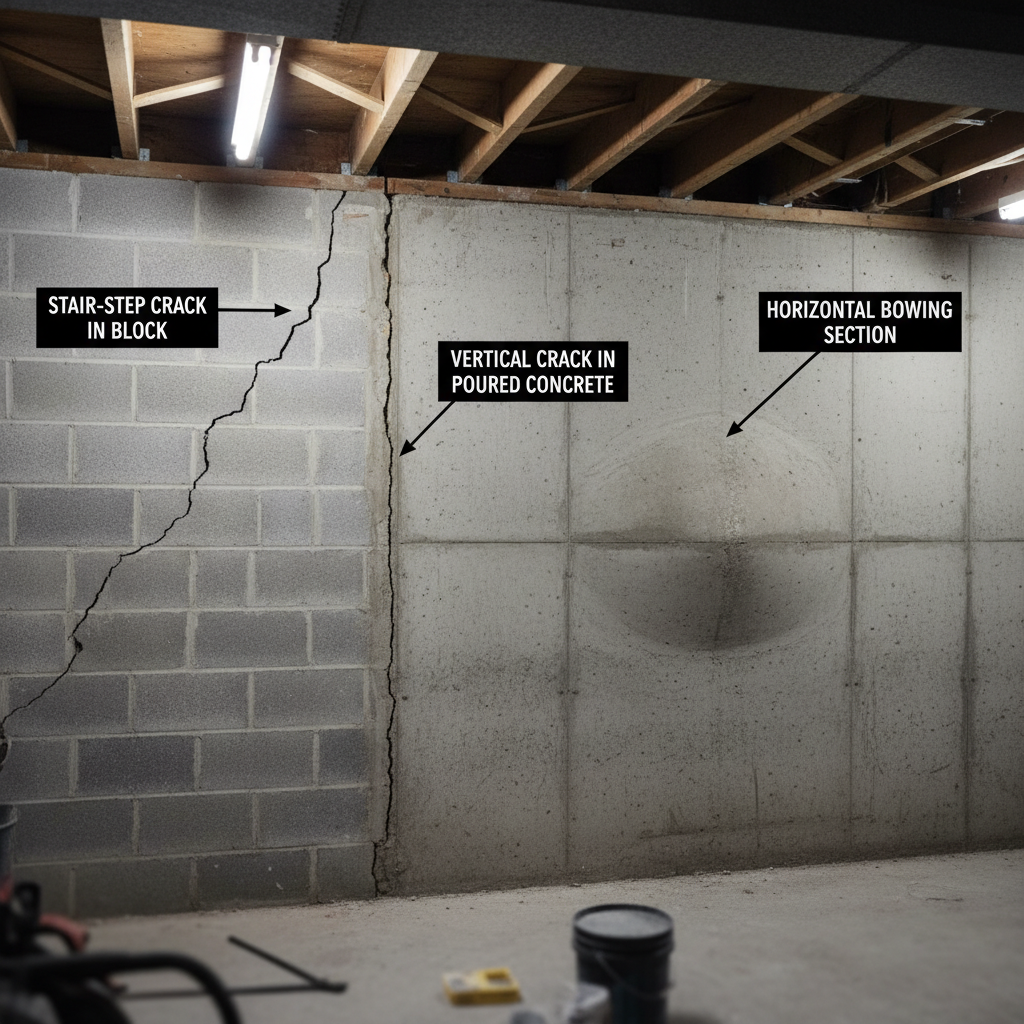
| Stair-step in brick/block | Differential settlement | Medium to high | Engineering assessment |
| Crack with active water flow | Hydrostatic pressure | Varies | Address waterproofing, assess structure |
Horizontal Cracks: Act Immediately
Horizontal cracks in foundation walls are the one crack type that requires immediate professional assessment, without waiting, without monitoring for six months, without seeing whether it gets worse.
A horizontal crack indicates that the lateral soil pressure against the wall has exceeded the wall’s resistance capacity. The soil is winning. In block walls, this appears at the mid-height of the wall because that is the point of maximum bending stress. As the crack widens, the wall can bow inward. Once significant bowing begins, wall replacement or major reinforcement is required.
The cost of addressing a horizontal crack early (carbon fibre straps at $3,000 to $8,000) is dramatically less than the cost of addressing it after significant bowing has occurred (wall replacement at $15,000 to $35,000).
Stair-Step Cracks in Brick and Block Foundations
Toronto has a large stock of pre-war homes with brick or concrete block foundations, particularly in the Annex, Riverdale, Cabbagetown, Parkdale, and Leslieville. These homes are highly prone to stair-step cracking.
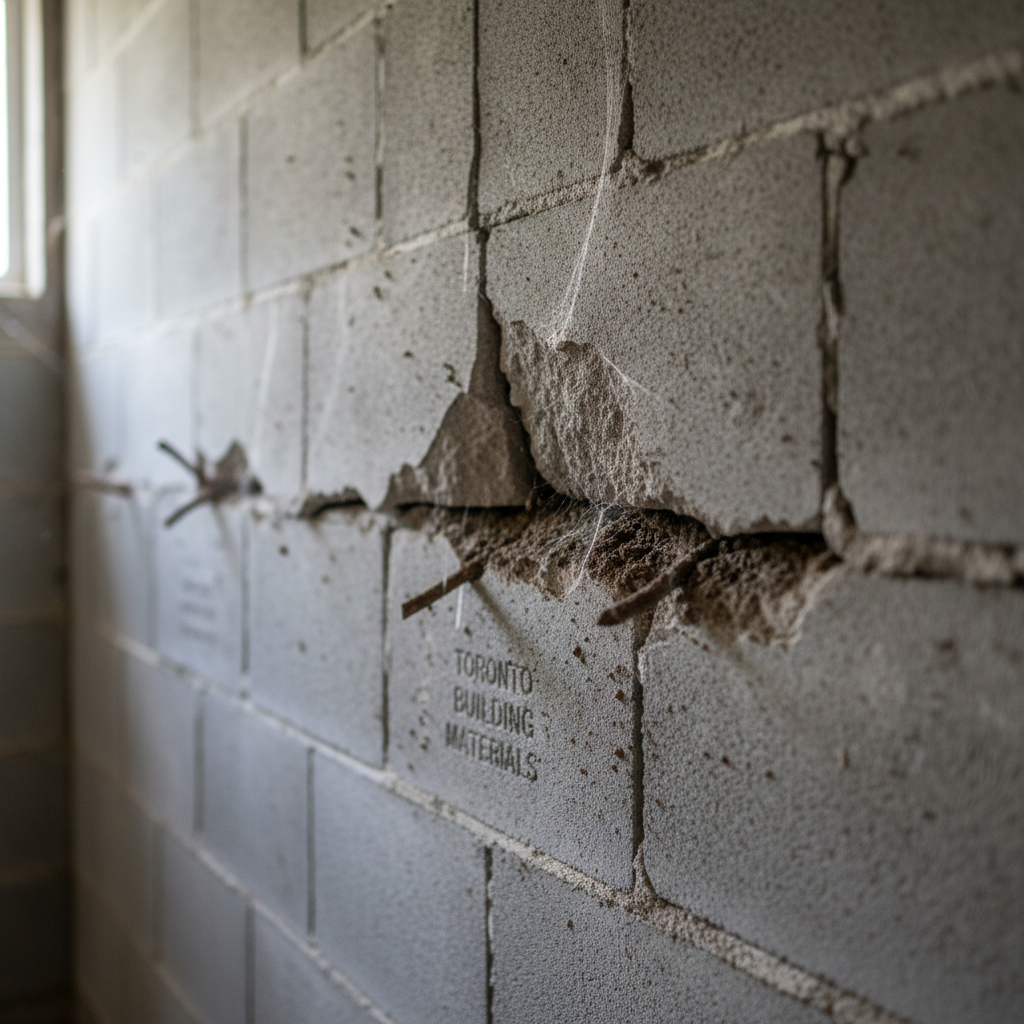
A stair-step crack follows the mortar joints because mortar is weaker than the brick or block itself. It indicates differential settlement: one section of the footing has dropped relative to adjacent sections.
Stable stair-step crack: Present for decades, no change in width or length, no displacement. These exist in many old Toronto homes and are the result of minor settling that occurred decades ago. They may simply need monitoring and tuck-pointing to prevent water entry.
Active stair-step crack: Widening seasonally, showing displacement, or appearing in multiple locations forming a pattern. This indicates ongoing differential settlement and warrants an engineering assessment to determine whether foundation repair or underpinning is required.
Monitoring Methods
For cracks that are in the monitoring category, here is the correct protocol:
Simple marking method: Use a permanent marker to mark the ends of the crack. Write the date next to each mark. Return at 30, 90, and 180 days to check whether the crack has extended beyond the marks.
Width measurement: Use a plastic crack gauge (available at hardware stores for under $20) to measure crack width at the widest point. Record with a date. Re-measure at the same point at 30, 90, and 180 days.
Photographic record: Photograph the crack with a ruler placed parallel to it for scale. Date each photo. Compare over time for visual changes.
What stable looks like: No change in length or width over 12 months, particularly through one full spring cycle (when frost heave and soil saturation are at maximum).
What Is NOT a Foundation Crack Problem
Not everything that looks like a crack is a structural issue. Two common sources of confusion:
Efflorescence is the white mineral deposit left behind when water migrates through concrete and evaporates on the surface. It often appears as a chalky white streak or crystalline deposit along a crack or through the concrete surface. Efflorescence is evidence of water migration but is not itself structural damage. The water migration it indicates does need to be addressed with waterproofing.
Surface spalling is the flaking or pitting of the concrete surface, common in pre-1960 concrete that was mixed with aggregates that react poorly to freeze-thaw cycles. Surface spalling does not indicate structural weakness unless it is very deep (more than 1 inch). Shallow spalling can be patched with hydraulic cement.
For further context, read our guides on Foundation Repair Cost and Signs Your Basement Needs Waterproofing.
Concerned about a crack in your Toronto home’s foundation? Contact our team for a foundation assessment that will give you a clear diagnosis and a straightforward repair recommendation.