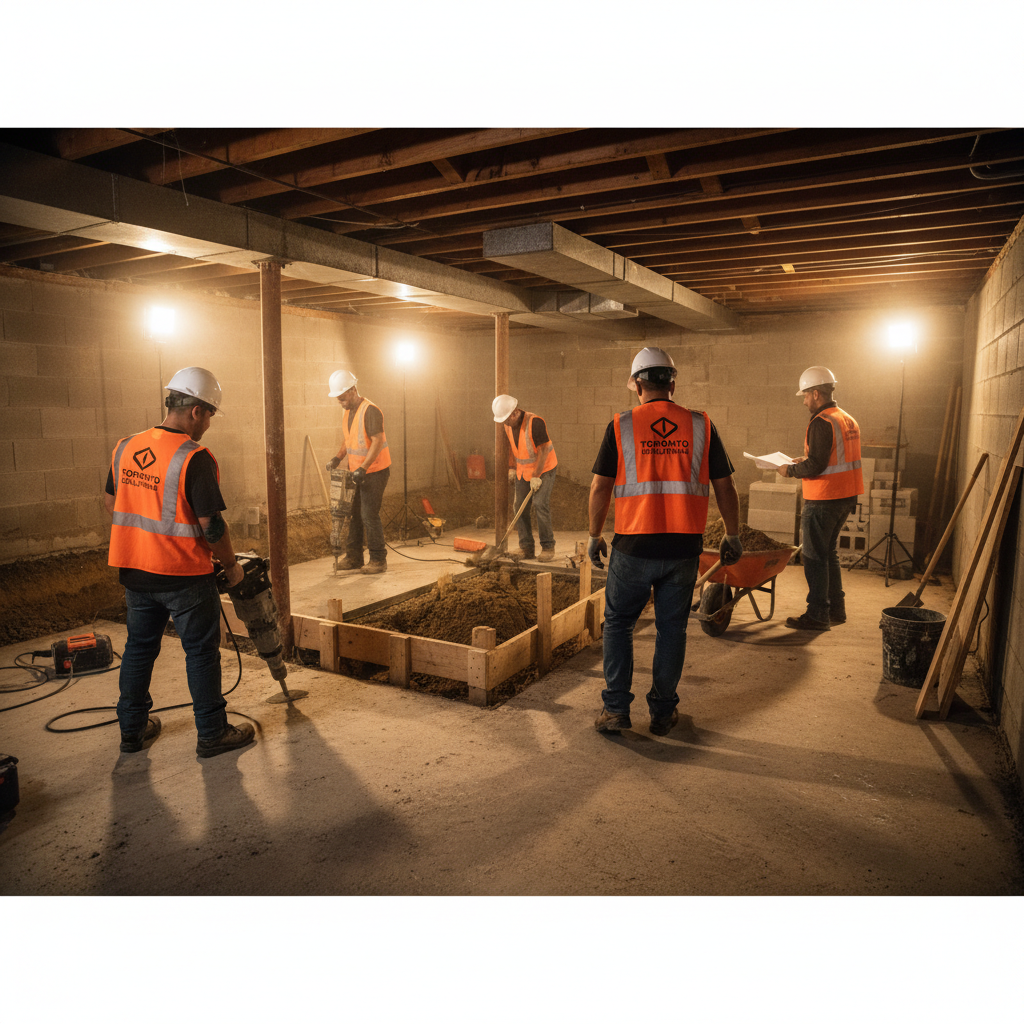
When Toronto homeowners discover they need to lower their basement, the conversation quickly arrives at two main options: full underpinning (extending the footings to a new depth around the full perimeter) and bench footing (creating a concrete ledge at the current footing level and only lowering the central floor). Both achieve ceiling height gain. Both require a building permit and engineering. But they differ substantially in cost, floor area impact, and suitability for different goals.
This guide gives you the tools to understand both options and make the right choice for your specific home and project.
How Each Method Works
Full Underpinning
Full underpinning involves excavating below the existing foundation footings, in alternating pin sections per the engineered sequence, and pouring new deeper concrete footings. Once all sections are complete and cured, the central floor area is excavated to the new footing depth and a new slab is poured at the lower elevation.
The result: the entire basement floor is at the new lower elevation. The foundation walls extend deeper. No floor area is lost to structural elements.
Bench Footing
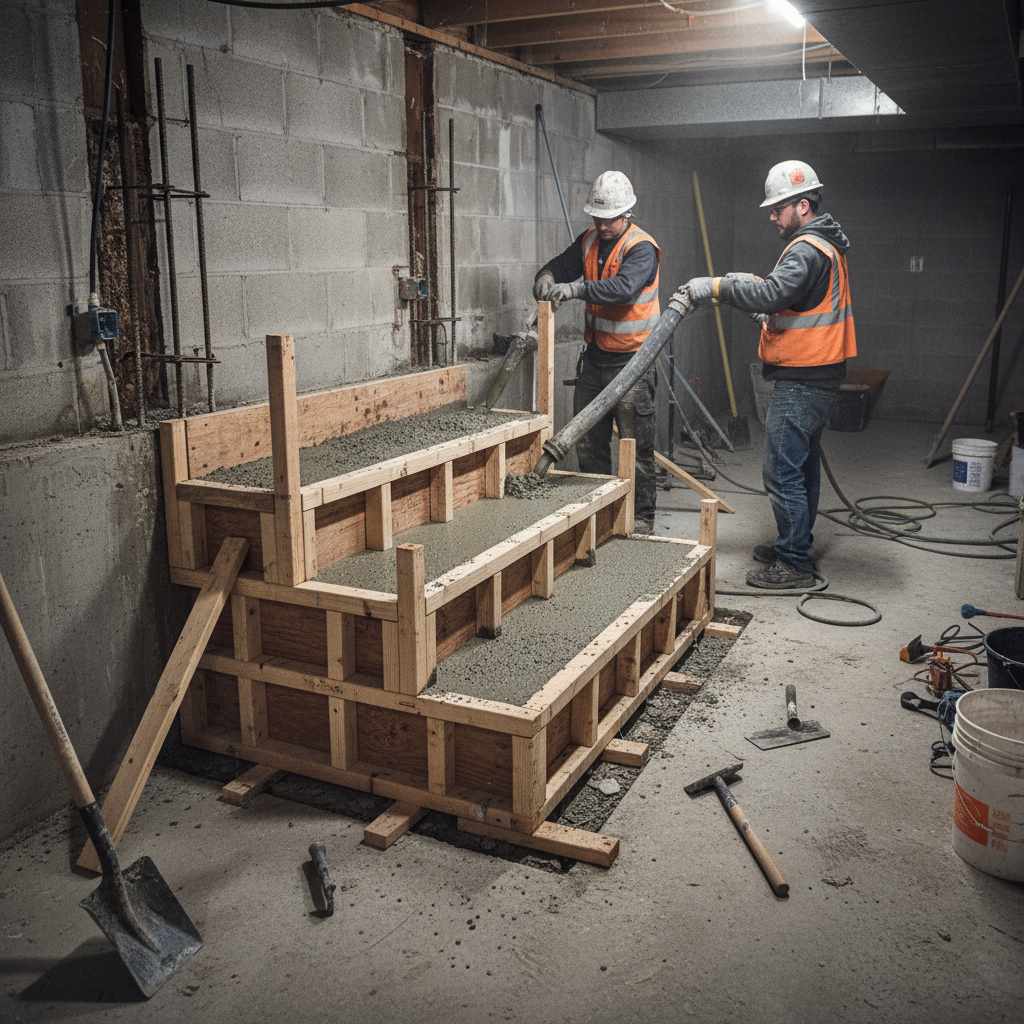
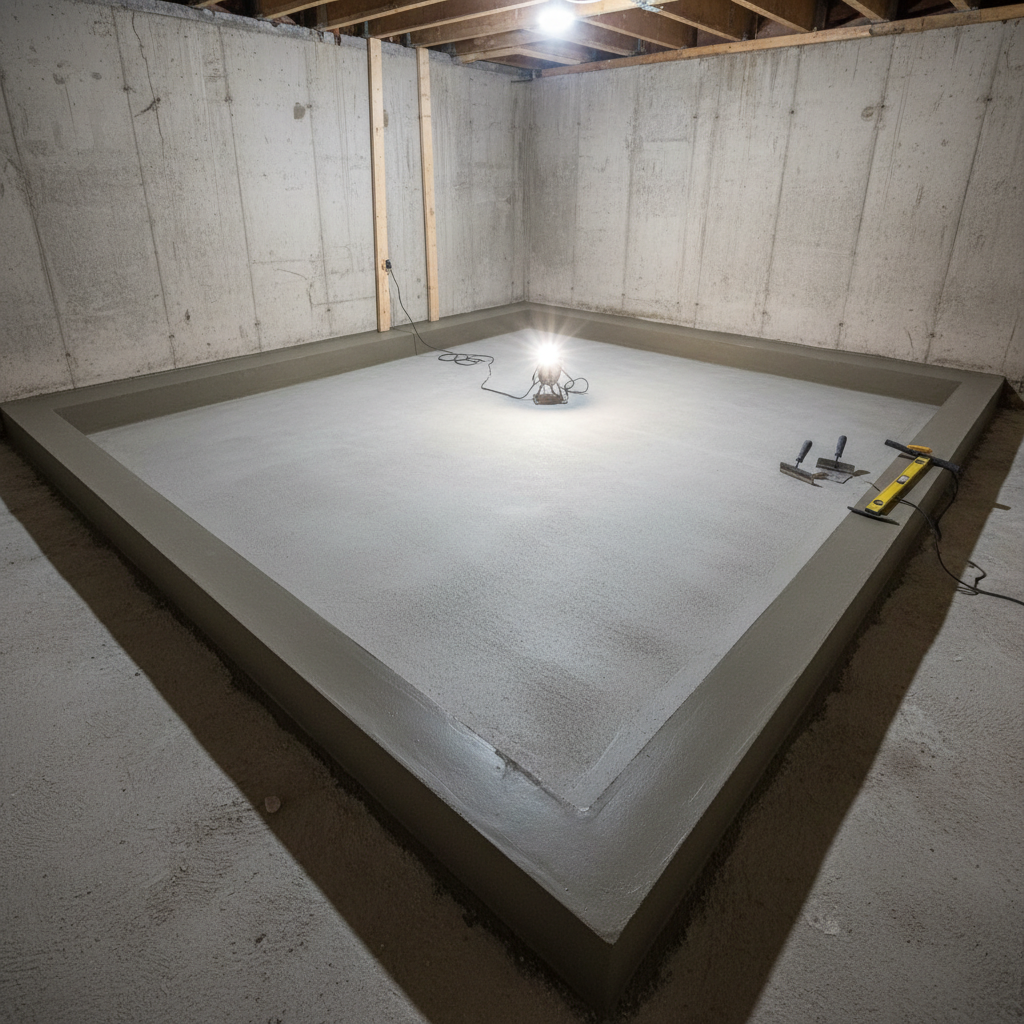
Bench footing involves a different approach to the perimeter. Instead of extending the existing footing downward, a new concrete bench (essentially a wide ledge) is formed at the existing footing level, extending into the interior of the basement typically 450mm to 600mm. The central area (everything inside the bench) is then excavated to the desired lower depth, and a new slab is poured at the lower elevation in the central area only.
The bench itself stays at the original floor elevation and creates a raised ledge around the perimeter of the basement. This ledge is structurally integral and cannot be removed later.
Side-by-Side Comparison
| Factor | Full Underpinning | Bench Footing |
|---|---|---|
| Typical cost in Toronto | $50,000 to $120,000 | $35,000 to $75,000 |
| Floor area impact | None | Loses 18 to 24 inch perimeter |
| Ceiling height gain | Up to 24 inches | Up to 24 inches (central area) |
| Perimeter ceiling height | Matches central | Same height as central |
| Structural disruption | Extensive (full perimeter) | Moderate (central excavation) |
| Permit required | Yes | Yes |
| Suitable for secondary suite | Yes | Yes (if sufficient central area) |
| Maximum usable floor space | Yes | No (perimeter bench consumes space) |
| Common for garages | No | Yes |
The Floor Area Trade-Off
The bench footing trade-off is entirely about floor area. The bench is permanent. It is structural. You cannot remove it later without underpinning the perimeter.
To quantify the impact:
Example: 1,000 sqft basement with 130-LF perimeter
A 20-inch (500mm) bench around the full perimeter:
- Perimeter consumed: 130 LF x 20 inches = 130 LF x 1.67 feet = approximately 217 sqft
- Remaining central floor area: 1,000 - 217 = 783 sqft
For a basement that will be used as a legal secondary suite, 783 sqft is still workable for a one-bedroom suite. For a basement where every square foot matters (perhaps a smaller semi-detached with only 700 sqft total), the bench approach may reduce the space below what a comfortable suite requires.
For basements intended as recreation rooms, home gyms, or open-plan family rooms, the bench becomes a significant design constraint. Furniture layout around a perimeter ledge is limiting.
What the bench can be used for:
The bench itself is not wasted space. It can be framed and finished as:
- Seating ledges (common in finished basements)
- Platform storage
- Window well surround if egress windows are at the bench level
- Raised surface for radiators or baseboard heaters
But it cannot be walked on as normal floor area.
When Bench Footing Is the Right Choice
Bench footing is genuinely appropriate in specific scenarios:
Budget is the primary constraint. If the underpinning budget is firm and full underpinning exceeds it, bench footing at 20 to 35 percent lower cost allows the project to proceed. A benched basement with adequate ceiling height is dramatically better than no change at all.
The basement is wide enough to absorb the bench. For large homes with basement footprints of 1,200 sqft or more, losing 20 inches of perimeter has a much smaller proportional impact than in a 600 sqft semi-detached basement. A 1,200 sqft basement loses approximately 260 sqft to a 20-inch bench, leaving 940 sqft of central floor area. That is more than adequate for virtually any intended use.
Garage conversion to living space. Converting a detached garage with a slab to habitable space often uses bench footing because the original slab is at a different elevation than the desired finished floor, and the perimeter structure needs reinforcement without full underpinning cost.
The intended use does not require full perimeter floor area. If the basement will be a simple family room or a utility/storage/workshop space rather than a secondary suite, the bench’s impact on usable area may be acceptable.
When Full Underpinning Is Required
Full underpinning is the right choice (or the only practical choice) when:
Maximum floor area is needed for a secondary suite. Legal suites require kitchen, bathroom, living area, and sleeping area. The functional space requirements effectively establish a minimum usable floor area that a benched basement may not meet in a smaller home.
The basement is too small to absorb a bench. Older Toronto semi-detached homes may have basement footprints of only 600 to 800 sqft. Losing 150 to 200 sqft to a bench leaves a very tight space for any intended use.
A future sale requires maximum demonstrable floor area. Finished basements are appraised and marketed by square footage. A benched basement’s “usable” area is debatable; a fully underpinned basement has a straightforward, unqualified floor area measurement.
The homeowner wants the project done once, definitively. A benched basement that is later sold to a buyer who wants full underpinning will require underpinning at that time, likely at a higher cost. If full underpinning is the eventual destination, doing it now avoids doing the work twice.
Cost Comparison for Typical Toronto Homes
| Home Type | Full Underpinning | Bench Footing | Difference |
|---|---|---|---|
| Small semi-detached (600 sqft, 100 LF perimeter) | $50,000 to $70,000 | $35,000 to $50,000 | $15,000 to $20,000 |
| Average detached (900 sqft, 120 LF perimeter) | $65,000 to $90,000 | $45,000 to $65,000 | $20,000 to $25,000 |
| Larger detached (1,200 sqft, 150 LF perimeter) | $80,000 to $120,000 | $55,000 to $80,000 | $25,000 to $40,000 |
Which Toronto Home Types Suit Each Method
Bench footing is most often chosen for:
- Large post-1960 detached homes where the perimeter area loss is manageable
- Garage conversions
- Projects where budget is the controlling constraint
- Basements that will be used for recreation, not rental
Full underpinning is most often chosen for:
- Pre-war semi-detached in Annex, Leslieville, Roncesvalles (tight floor areas)
- Any project targeting a legal secondary suite in a home under 1,000 sqft
- Homes where the investment in underpinning is being leveraged for maximum rental income
- Homeowners who value a clean, uncompromised floor plan
For further context, read our guides on Basement Ceiling Height Requirements and What to Expect During Basement Underpinning.
Not sure whether full underpinning or bench footing makes more sense for your home? Contact our team for a site assessment that includes engineering guidance on both options with cost estimates specific to your property.