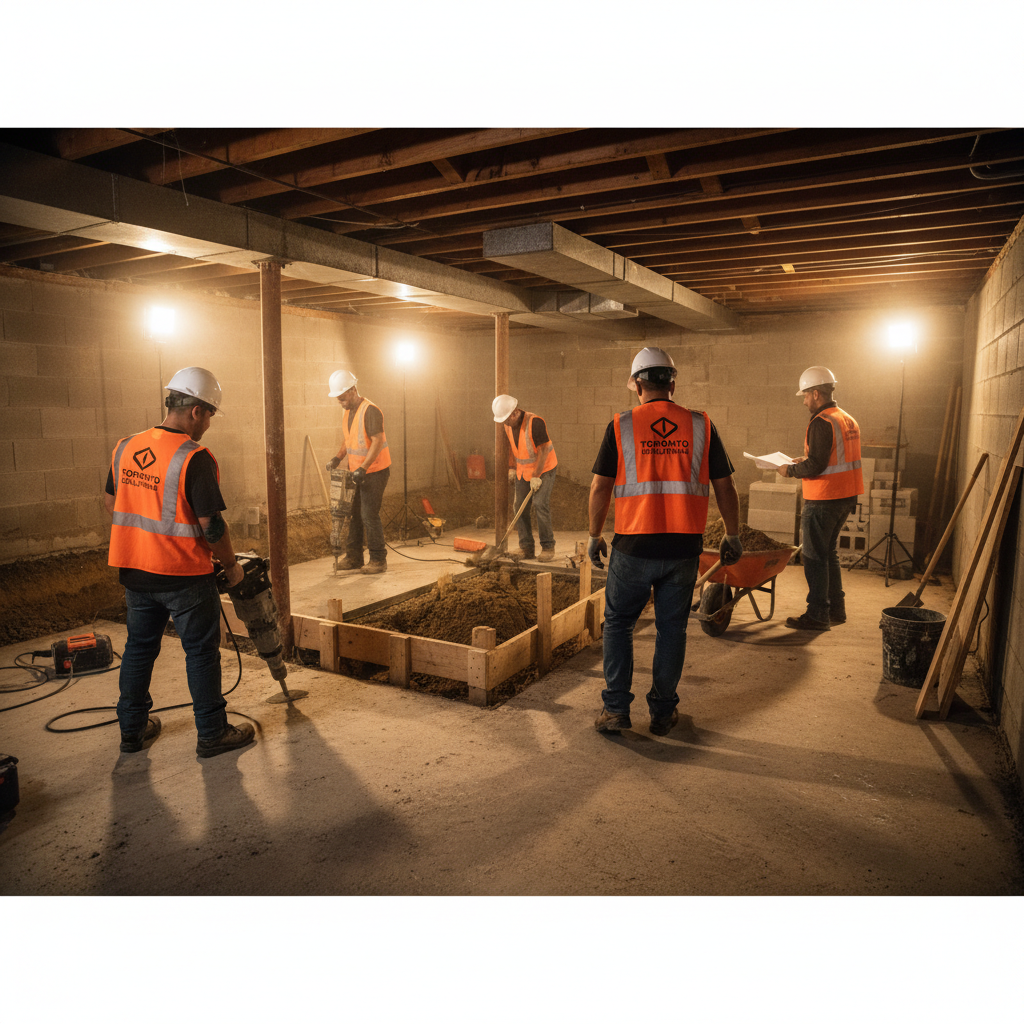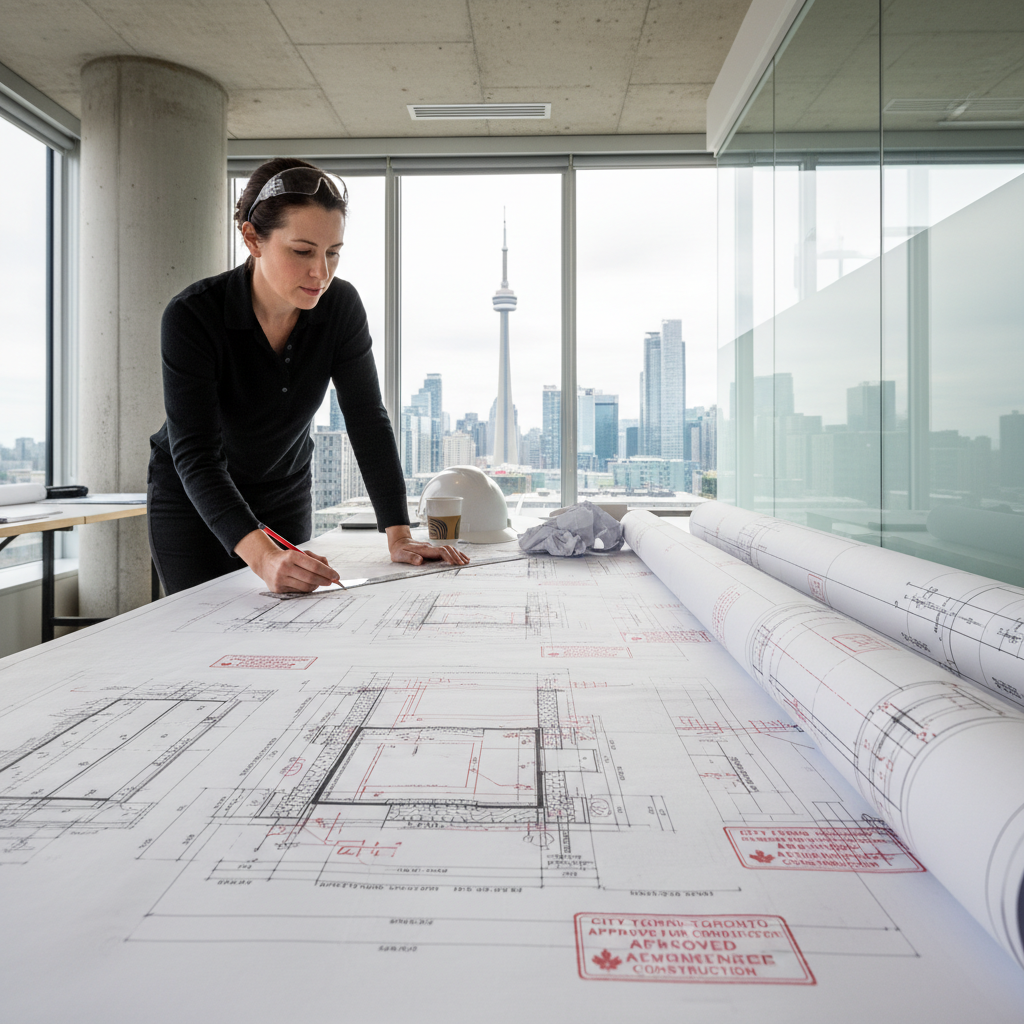
Basement underpinning cannot begin without a set of engineered drawings that define exactly how the structural work will be done. These drawings are submitted with the building permit application and remain on-site throughout construction as the contractor’s guide and the inspector’s reference. No drawings, no permit. No permit, no legal work.
Understanding what goes into the drawing package helps homeowners ask the right questions when selecting a contractor and avoid the common mistake of signing a construction contract before confirming who is responsible for the engineering.
Why the City of Toronto Requires Drawings
The City of Toronto requires structural drawings for all foundation alterations because underpinning extends the structural elements the entire building depends on. Ontario Building Code Section 9.13 governs structural foundation alterations. The permit drawing requirement exists for three specific reasons.
First, inspectors use the drawings at mandatory site inspections to verify the work matches what was approved. Without approved drawings on-site, inspections cannot proceed and construction must halt.
Second, the drawings establish the excavation sequence. The pin-section sequence diagram tells every crew member which sections can be open simultaneously. This is not a formality: improperly sequenced underpinning excavations have caused partial building collapses. The drawing is the safety document.
Third, the drawings become a permanent record. Future owners, insurance adjusters, and lenders can review what structural work was performed, by whom, and to what standard. This matters at resale and at claim time.
A contractor who says underpinning can be done without drawings and permits is either describing illegal work or does not understand the regulatory requirements. Either way, do not proceed.
The Five Components of a Complete Drawing Package
A complete underpinning drawing package for a City of Toronto building permit contains five specific documents. Each serves a distinct purpose and all five must be present for the application to be accepted.
1. Site Plan
A scaled plan showing property lot lines and dimensions, the building footprint with dimensions, required setbacks from lot lines, the location of any accessory structures such as a garage or shed, and a north arrow with scale indicator.
The site plan establishes that the project falls within the zoning envelope and gives the plan reviewer context about the property. If the project involves a new secondary suite, the site plan must also show parking, outdoor amenity space, and other zoning-compliance elements.
2. Foundation Plan
A scaled plan of the existing foundation showing foundation wall locations and dimensions, existing footing dimensions measured from as-built records or direct on-site measurement, existing slab thickness and current floor elevation, the location of all structural openings including windows, stairs, and access hatches, and the proposed new footing extent and depth overlaid on the existing foundation.
The foundation plan documents what currently exists versus what will be built. The overlay makes the scope of work immediately clear to a plan reviewer.
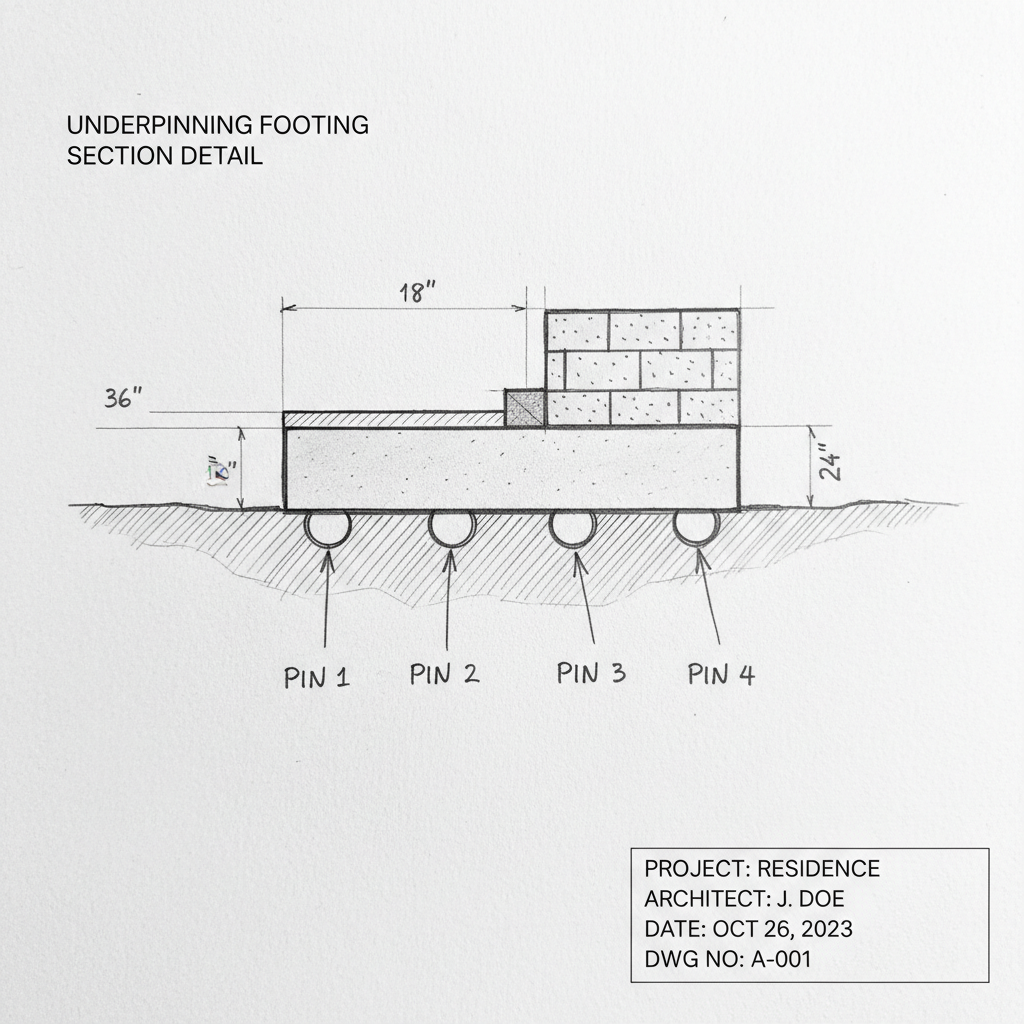
3. Footing Section Details
Cross-section drawings showing the existing footing dimensions and depth, the new footing extension dimensions including width, thickness, and depth, the new footing depth relative to the frost line (minimum 1.2 metres below grade in Toronto), the concrete specification (minimum 25 MPa for residential underpinning footings), reinforcement details if the engineer specifies rebar, and the mechanical key or hook connection between the new footing extension and the existing footing.
These section details are what the inspector examines at the footing-before-pour inspection. The inspector reviews the actual excavated section against the approved drawing before concrete can be placed. If the dimensions do not match, the pour is stopped.
4. Pin Sequence Diagram
A foundation plan annotated to show each pin section numbered in the order it is to be excavated and poured, pin section dimensions (typically 900 mm to 1,200 mm wide for residential projects), the maximum span between simultaneously open sections, and the required curing time between adjacent pours.
This diagram makes underpinning structurally safe. It ensures no crew can skip or reorder the excavation sequence without the deviation being immediately visible against the approved drawings. Inspectors check sequence compliance during site visits.
5. Schedule 1 (Designer Information)
Required by the Ontario Building Code Act: a signed declaration from the engineer of record confirming they designed the project and accept professional responsibility for the structural elements. Without this form, the permit application is incomplete and will be returned.
Who Prepares the Drawings
An Ontario Professional Engineer (P.Eng.) with structural engineering designation prepares and stamps the drawings. In some cases, an architect coordinates the overall project package and the structural engineer provides the structural components as part of the architect’s submission.
The engineer must conduct an on-site assessment before drawings can be prepared. This assessment involves measuring existing footing dimensions and depth (often requiring test pits), assessing soil conditions, confirming the current ceiling height and target depth after underpinning, and identifying constraints such as interior columns, plumbing penetrations, or shared walls.
The assessment typically takes 2 to 4 hours on-site. Drawing preparation follows over 2 to 4 weeks depending on project complexity.
What the Drawings Cost
When engaged separately from construction, architectural and structural drawings for a standard Toronto residential underpinning project cost $3,000 to $6,000. Variables that affect the fee include:
| Factor | Impact on Cost |
|---|---|
| Foundation perimeter length | Larger homes require more detail pages and more engineering time |
| Soil conditions | Complex or variable soils require geotechnical input |
| Shared walls (semi-detached, townhouse) | Requires additional party wall analysis and potentially a party wall agreement |
| Secondary suite scope | Additional drawings for suite-specific code compliance |
| Heritage designation | Heritage Conservation District properties require additional review |
Most turnkey underpinning contractors bundle the drawing cost into the overall project price. When comparing quotes, confirm explicitly whether drawings and permit fees are included or are separate line items.
Common Drawing Package Errors That Delay Permits
Errors in the drawing package trigger a Deficiency List from the City of Toronto plan reviewer, adding weeks to the permit timeline. The most common errors in residential underpinning submissions are:
Footing section details that do not specify the mechanical key connection between old and new concrete. The key is how the new pour bonds to the existing footing, and reviewers consistently flag its absence.
Pin sequence diagrams that do not specify curing times between adjacent pours. Without specified curing times, the sequence is incomplete and the application is returned.
Site plans that omit accessory structures. If a garage or shed exists on the property and is not shown, the reviewer will request a revision.
Foundation plans based on assumed footing dimensions rather than measured ones. Engineers who work from assumptions rather than test pits produce drawings that do not reflect actual conditions. Inspectors notice.
What Happens If Work Starts Without Approved Drawings
Starting underpinning without a permit and approved drawings is an offence under the Ontario Building Code Act. Consequences include stop-work orders requiring all excavation to be backfilled immediately, fines starting at $25,000 for individuals and $50,000 for corporations, and the requirement to expose completed work for retroactive inspection, which typically means breaking out concrete that was already poured.
Unpermitted structural work also creates title problems. Title insurers will not cover unpermitted structural alterations. Lenders will not advance funds on a property with outstanding permit violations. The cost of retroactive compliance almost always exceeds what the permit would have cost.
How to Confirm Drawings Are Included in Your Quote
Before signing any underpinning contract, ask three specific questions:
Does this quote include an on-site assessment by a licensed structural engineer before construction begins? The assessment must happen before drawings can be prepared.
Does this quote include preparation and submission of the permit drawing package including the site plan, foundation plan, footing section details, pin sequence diagram, and Schedule 1? Each document should be explicitly named.
Does this quote include permit fees charged by the City of Toronto? Permit fees for residential underpinning projects typically run $2,000 to $4,000 based on project value, calculated at the City’s current rate of $18.56 per $1,000 of construction value.
If any of these items are listed as extras, get the additional cost in writing before signing.
Request a free estimate and ask about our complete drawings and permit coordination service. For the full permit timeline and what happens after drawings are submitted, see the City of Toronto permit process for underpinning.
For further context, read our guides on Basement Underpinning Cost and What Is Basement Underpinning?.